
نوع مقاله : مقاله پژوهشی
چکیده تصویری
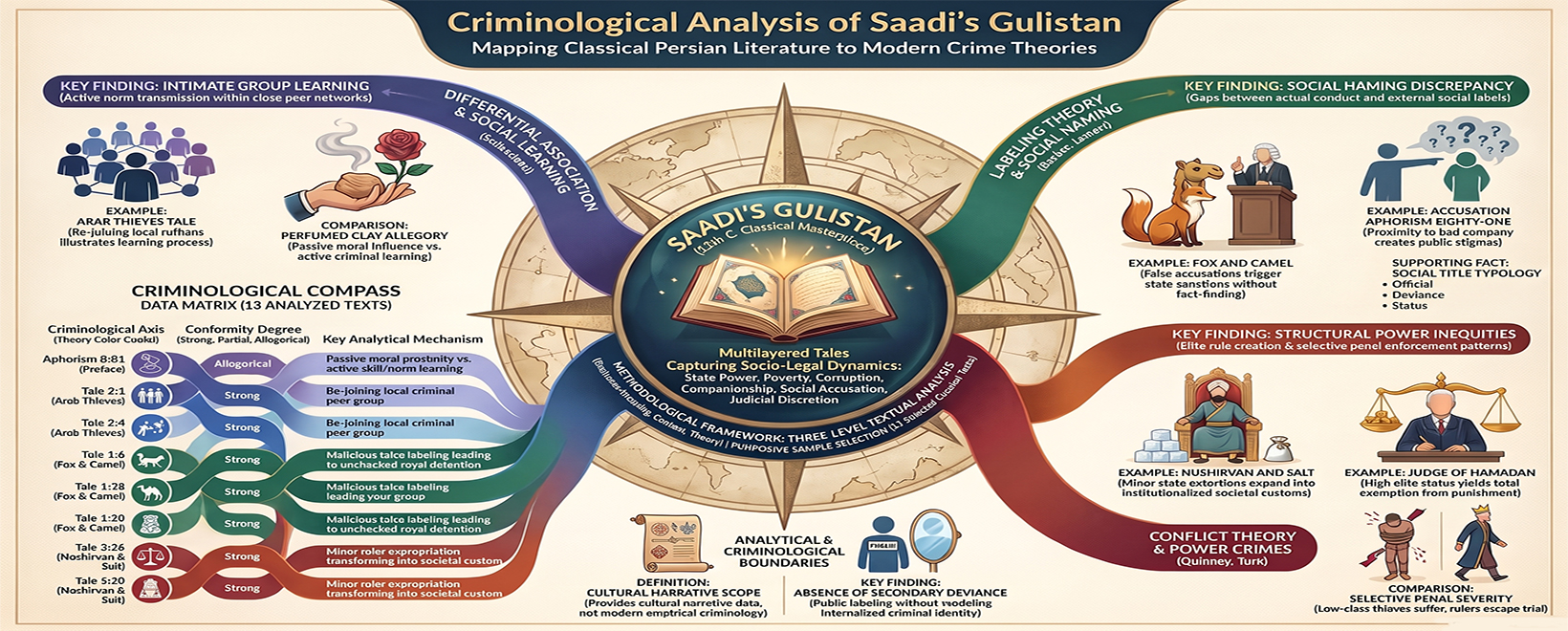
عنوان مقاله English
نویسنده English
Objective: Saadi’s Gulistan, in addition to its literary and ethical standing, is a text replete with social representations of power, poverty, education, companionship, status, corruption, and collective judgment. The present study, employing a qualitative, interdisciplinary, and text-centered approach, analyzes selected tales of the Gulistan on the basis of three theories: differential association, labeling, and conflict. The principal question of the research is: In what instances and with what limitations are the selected tales of the Gulistan amenable to criminological analysis in light of these three theories?
Method: To answer the research question, the entire text of the Gulistan (the preface and eight chapters) was examined, and from among the candidate texts, thirteen texts (ten tales, two aphorisms, and one versified allegory) were selected on the basis of explicit inclusion and exclusion criteria. Each text was analyzed at three levels textual signification, interpretive reading, and theoretical application and its degree of conformity with the central mechanism of each theory was assessed.
Results: The findings indicate that the Gulistan is not a criminological text, nor is Saadi to be regarded as a modern criminologist; nevertheless, the tale of the Arab thieves tribe owing to the young man’s re-joining the ruffians of his quarter conforms more closely to Sutherland’s differential association than does the allegory of the sweet-smelling rose, the aphorism Let the accused be attributed and the tale of the fox and the camel represent the core of labeling, namely the gap between the act and the social name, and the tales of Nushirvan and salt, the thief and the beggar, and the judge of Hamadan demonstrate that the Gulistan’s link with conflict theory, beyond the moral critique of the ruler, is manifested in the transformation of the powerful’s conduct into custom, the selective enforcement of punishment, and the exemption of the holders of status from punishment.
Conclusion: The conclusion of the research is that the Gulistan, while observing fidelity to the text and avoiding the imposition of new concepts upon Saadi’s historical world, can serve as a cultural and educational source for a more indigenous understanding of certain concepts of criminology and criminal justice.
کلیدواژهها English
