
نوع مقاله : مقاله پژوهشی
چکیده تصویری
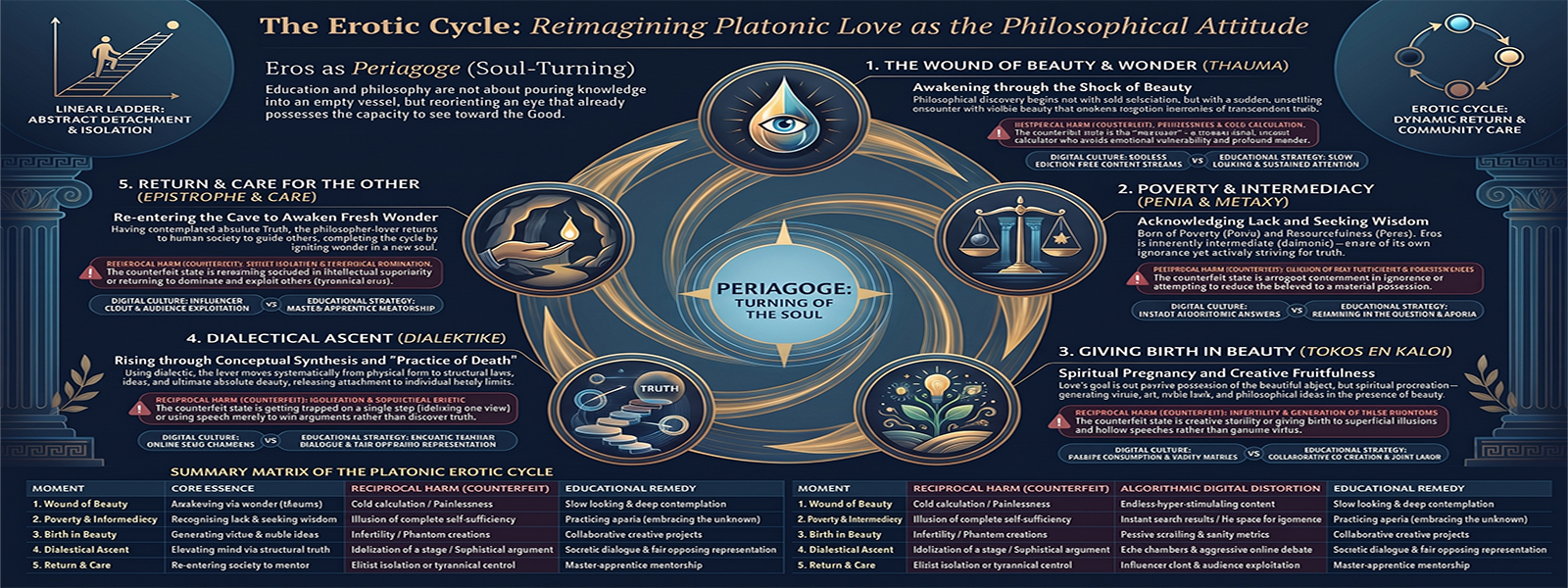
عنوان مقاله English
نویسندگان English
Objective: This article demonstrates that love (eros) in Plato''s thought is not merely one human emotion alongside others, but rather the very form of the philosophical attitude itself; philosophia, in the precise sense of the term, is the eros of wisdom. Previous studies, whether in Persian or English, have largely examined Platonic love either in the form of the ladder of ascent in the Symposium or in the form of divine madness in the Phaedrus, and have less frequently addressed the question of how love shapes the philosopher''s manner of seeing, questioning, and living.
Method: The research method is descriptive-analytical, employing a hermeneutic approach and conceptual reconstruction, reading the Symposium, Phaedrus, Theaetetus, Phaedo, and Republic with reliance on Stephanus pagination.
Results: The findings reconstruct the philosophical attitude of love in five interconnected moments: the wound of beauty and wonder, poverty and intermediacy, giving birth in beauty, dialectical ascent, and return and care for the other. These moments do not constitute a one-directional staircase; the perfected lover returns toward others and awakens fresh wonder in them. The article''s innovation is threefold: (1) proposing the cyclical model of the erotic cycle in place of the linear reading of the ladder of love; (2) defining the reciprocal harm of each moment (such as possessiveness, idolization of the beloved, and elitist isolation), which enables the assessment of philosophical love; (3) applying the model to algorithmic eros in contemporary digital culture.
Conclusions: The conclusion is that Platonic love is not a flight from the beloved, but rather the turning of the soul (periagoge) toward beauty and the good a turning that is completed only when it culminates in the birth of virtue in the other.
کلیدواژهها English
