
نوع مقاله : مقاله پژوهشی
چکیده تصویری
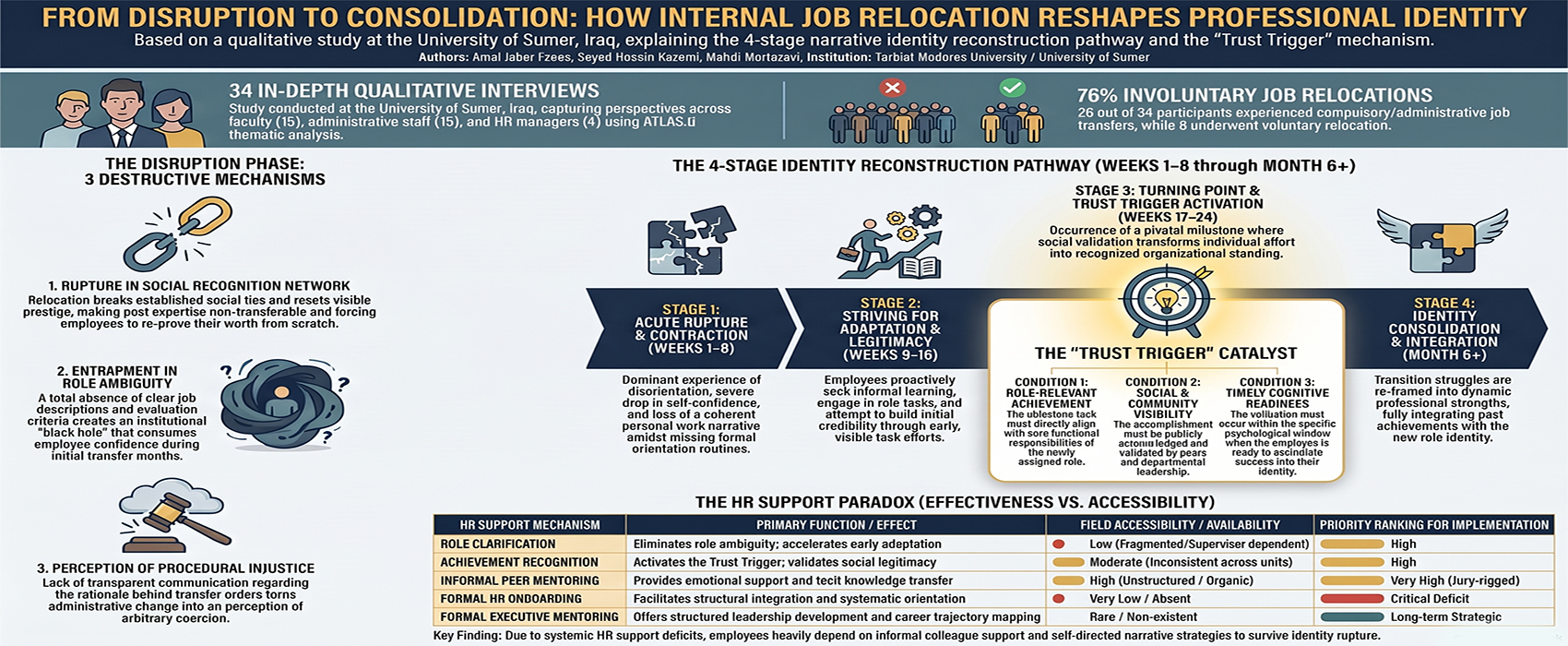
عنوان مقاله English
نویسندگان English
Objective: The present study undertakes an examination of how the phenomenon of intra organizational job rotation activates the dynamic process of narrative identity work within the context of Iraq's public higher education system. In this regard, human resource management practices have been conceptualized not as merely administrative instruments, but rather as narrative scaffolds capable of smoothing the arduous path of employees transition from the phase of identity rupture toward stabilization and coherence, or conversely, of obstructing it.
Method: Based on a qualitative and interpretive research design, field data were collected through 34 in-depth semi-structured interviews with faculty members, administrative staff, and human resource specialists of the University of Sumer, Iraq, and were analyzed using thematic analysis with the aid of ATLAS.ti software.
Results: The findings indicate that job rotation effectively functions as a narrative trigger and catalyst, disrupting and fragmenting the individual's identity continuity through three destructive mechanisms: disturbance and rupture in the social recognition network, entrapment in role ambiguity, and the perception of procedural injustice. To heal this identity rupture, the organizational subject traverses a four-stage reconstruction pathway whose culmination crystallizes in an emerging mechanism termed the trust trigger; this construct is a novel proposed pathway that explains how a socially visible, role-relevant achievement, occurring within a time window of the individual's cognitive readiness, will function as a reinforcing factor in the stabilization of their professional identity. Furthermore, within the research context, a fundamental paradox between accessibility and effectiveness was revealed: the most effective human resource management support mechanisms were, in practice, the least accessible and rarest in the field.
Conclusions: The innovation of this study lies in introducing the trust trigger as a theoretical and novel construct that extends the boundaries of identity work theory to contexts and atmospheres afflicted by resource constraints, and thereby yields path breaking implications for reimagining the role of human resource management as a narrative scaffold builder.
کلیدواژهها English
